How to Buy the Right RF Chamber for Your Lab
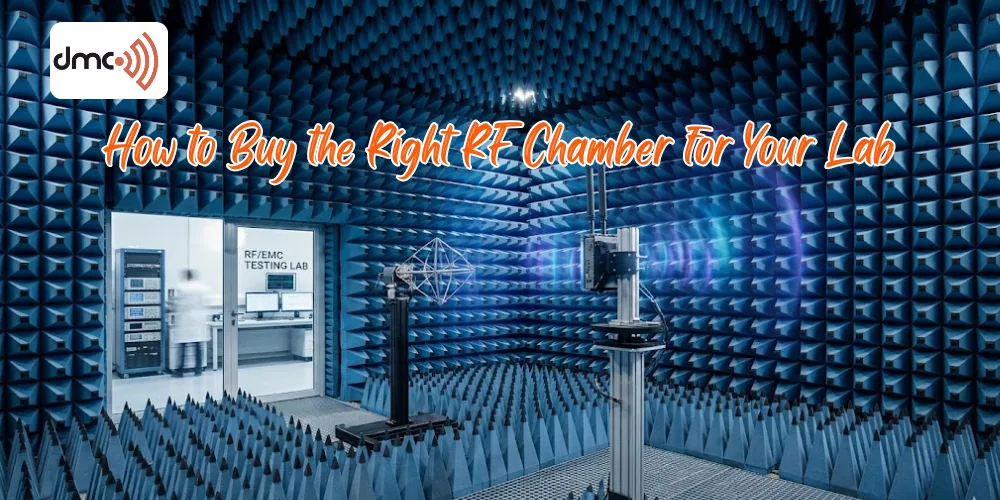
Table of Contents
- What Is an RF Chamber and Why Does It Matter?
- Types of RF Chambers
- Key Factors to Consider When Buying an RF Chamber
- RF Chamber Comparison Table
Choosing to Buy Right RF Chamber is one of the most critical decisions any testing lab will make, as it directly impacts the accuracy, reliability, and compliance of your results. Setting up an RF (Radio Frequency) testing environment is a major investment, and selecting the wrong chamber can lead to costly errors, failed certifications, and operational inefficiencies. Whether you're testing wireless devices, performing electromagnetic compatibility (EMC) evaluations, or ensuring adherence to global regulatory standards, the importance of choosing the right RF chamber cannot be overstated.
This guide walks you through every critical factor to consider before purchasing an RF chamber, helping you make a confident, well-informed decision that aligns with your lab's mission, budget, and long-term goals.
What Is an RF Chamber and Why Does It Matter?
An RF chamber - also called a shielded enclosure, anechoic chamber, or EMC test chamber - is a specially designed room or enclosure that either blocks external electromagnetic signals from entering, or prevents internal signals from escaping (or both).
These chambers are essential for:
- Regulatory compliance testing (FCC, CE, ISED, etc.)
- Wireless device characterization (Wi-Fi, Bluetooth, 5G, IoT)
- Military and defence electronics testing
- Medical device EMC validation
- Automotive electronics and radar testing
The quality and type of RF chamber you select directly impacts the accuracy of your test results, the speed of your testing workflows, and whether you'll pass regulatory audits the first time around.
Types of RF Chambers
Before diving into specs, you need to understand the different Types of Chambers available. Each serves a distinct purpose:
1. Fully Anechoic Chambers (FAC)
These rooms are lined with RF-absorbing material on all surfaces, including the floor. They simulate free-space conditions and are ideal for antenna radiation pattern measurements and OTA (Over-the-Air) testing.
2. Semi-Anechoic Chambers (SAC)
Similar to FACs but with a conductive, reflective floor. The floor simulates a ground plane - the standard configuration for most radiated emissions and immunity testing per CISPR and FCC standards.
3. Reverberation Chambers
These are highly reflective enclosures that create a statistically uniform field distribution. They're excellent for immunity testing and measuring total radiated power (TRP) and total isotropic sensitivity (TIS) of wireless devices.
4. RF Shielded Rooms (Faraday Cages)
These provide RF isolation without absorber lining. They're used for conducted testing, preventing external interference, and protecting sensitive equipment from ambient RF noise.
5. Compact Antenna Test Ranges (CATR)
Specialized chambers using a parabolic reflector to convert spherical wavefronts into planar waves, enabling far-field antenna measurements in a small space.
Key Factors to Consider When Buying an RF Chamber
1. Frequency Range
The most fundamental specification is the frequency range the chamber must support. Modern wireless devices operate across a wide spectrum - from sub-1 GHz IoT devices to millimeter-wave 5G at 28 GHz and beyond.
- Low-frequency chambers (below 1 GHz) require larger absorbers and more physical space.
- High-frequency chambers (above 18 GHz) demand precision-engineered absorbers and careful seam shielding.
- Always buy a chamber rated slightly beyond your current highest frequency to future-proof your investment.
2. Shielding Effectiveness (SE)
Shielding effectiveness measures how well the chamber attenuates external electromagnetic signals, expressed in decibels (dB). The higher the SE, the better the isolation.
- Basic: 40-60 dB SE
- Required for most commercial EMC testing: 80-100 dB SE
- Defense, intelligence, and TEMPEST applications: 100-120+ dB SE
Verify SE ratings are certified per IEEE 299 or MIL-STD-461 standards, not just manufacturer claims.
3. Chamber Size and Quiet Zone
The 'quiet zone' is the area within the chamber where electromagnetic field uniformity meets specification. All device-under-test (DUT) measurements occur within this zone.
- The DUT should not exceed one-third of the quiet zone diameter.
- Allow additional space for antennas, positioners, and cables.
4. Absorber Material and Performance
For anechoic chambers, absorber quality is everything. Look for:
- Carbon-loaded polyurethane foam - good broadband absorption, widely available.
- Ferrite tiles + hybrid absorbers - essential for low-frequency performance below 1 GHz.
- Pyramidal absorbers offer better normal-incidence performance; wedge absorbers improve oblique-incidence behavior.
Always request the absorber's reflectivity curves across your target frequency range before purchasing.
5. Door Design and RF Sealing
The chamber door is the most vulnerable point for RF leakage. A poor door seal can compromise an otherwise excellent chamber.
- Knife-edge contact doors provide consistent compression around the perimeter.
- Multi-point locking mechanisms ensure uniform pressure.
- Always request SE measurements specifically at the door seam.
6. Ventilation and Environmental Control
Testing standards often specify temperature and humidity ranges. Your chamber must accommodate HVAC integration without compromising shielding, cable management ports (filtered penetration panels), and power line filters rated for your equipment's current draw.
RF Chamber Comparison Table
| Feature | Anechoic Chamber | Reverberation Chamber | Shielded Room |
|---|---|---|---|
| Best Use Case | Radiated emissions, OTA testing | Immunity, TRP/TIS measurements | Conducted testing, RF isolation |
| Frequency Range | 1 GHz - 110 GHz+ | 100 MHz - 40 GHz | DC - 40 GHz |
| Field Uniformity | High (controlled) | Statistical (stirrer-based) | N/A |
| Typical SE (dB) | 80 - 100 dB | 80 - 100 dB | 60 - 120 dB |
| Setup Complexity | High | Medium | Low |
| Relative Cost | $$$$ | $$$ | $$ |
| Space Required | Large | Medium | Flexible |
| Regulatory Standards | CISPR 16, FCC Part 15 | IEC 61000-4-21 | MIL-STD-461, IEEE 299 |
| Turntable/Positioner | Required | Optional | Not needed |
| Calibration Frequency | Annual | Semi-annual | Annual |
PRO TIP: Don't Just Buy for Today's Tests
One of the most common and costly mistakes labs make is buying an RF chamber sized and specced for their current product line - and then outgrowing it within two to three years.
Before finalizing any purchase, map out your lab's 5-year product roadmap. Ask:
- Will you be testing larger devices?
- Moving into millimeter-wave frequencies?
- Pursuing 5G NR or Wi-Fi 7 certifications?
Ask your vendor about modular expansion options and negotiate for retrofit absorber packages as future add-ons. A chamber that grows with your lab is always a better investment than the cheapest option available today.
Hidden Costs to Budget For
The sticker price of an RF chamber is just the beginning. Budget for the following additional expenses:
- Installation and site preparation - structural reinforcement, flooring, HVAC upgrades.
- Antenna systems and positioners - masts, turntables, multi-axis positioners.
- Test software and measurement receivers - spectrum analyzers, signal generators, EMC software suites.
- Annual calibration and re-certification - NVLAP or A2LA-accredited labs charge significantly.
- Training - your team needs to be trained on chamber operation and test procedures.
- Maintenance contracts - RF gaskets wear out; absorbers can degrade and need replacement.
Plan to add 30-50% on top of the chamber price to account for these ancillary costs.
Vendor Evaluation Checklist
When shortlisting vendors, ask these critical questions:
- Can you provide third-party SE test reports per IEEE 299?
- What is the chamber's site attenuation performance at my target frequencies?
- Do you offer turnkey installation including antenna systems?
- What is the warranty period and what does it cover?
- Do you offer NVLAP-accredited calibration services?
- Is there a reference customer I can contact who uses this chamber for similar testing?
- What is the lead time from order to installation?
When to Consider a Pre-Owned Chamber
Used or refurbished RF chambers can offer significant savings - sometimes 40-60% off new prices. However, proceed carefully:
- Always request a full SE test report dated within the last 12 months.
- Inspect absorber condition in person; degraded absorbers are expensive to replace.
- Verify that chamber dimensions match your space and quiet zone requirements.
- Factor in relocation, reassembly, and re-certification costs, which can be substantial.
Buying the right RF chamber is a high-stakes decision that demands careful technical analysis, thorough vendor due diligence, and a clear-eyed view of your lab's current and future needs. By understanding the different chamber types, scrutinizing key specs like shielding effectiveness and absorber performance, and budgeting for the full cost of ownership, you position your lab to deliver reliable, defensible test results for years to come.
Leave a Reply