RF Anechoic Chamber Buying Checklist 2026
Table of Contents
- What Is an RF Anechoic Chamber?
- The Complete RF Anechoic Chamber Buying Checklist
- Evaluate RF Absorber Type and Performance
- Assess the RF Door and Shielded Entry System
RF Anechoic Chamber Buying Checklist 2026 A must-read guide for EMC labs, antenna testing, and wireless setups to avoid costly mistakes and ensure compliance.
Whether you're setting up an EMC complia nce lab, an antenna measurement facility, or an in-house wireless testing environment, buying an RF anechoic chamber is one of the most significant capital investments your organization will make. A poorly specified chamber can lead to inaccurate test results, regulatory non-compliance, and costly retrofits-sometimes exceeding the original purchase price.
The RF Anechoic Chamber Buying Checklist 2026 is designed for RF engineers, procurement teams, and lab managers who want to make a confident, well-informed purchase. From understanding shielding effectiveness to evaluating vendors and planning future scalability, this guide covers every critical decision point.
What Is an RF Anechoic Chamber?
An RF anechoic chamber is a specially engineered room designed to absorb reflections of electromagnetic waves while also blocking external signals from entering or interfering with measurements inside. The term "anechoic" literally means "without echo." These chambers are lined with RF absorber material - typically pyramidal or ferrite tile absorbers - that prevents signal reflections.
They are used for:
- EMC (Electromagnetic Compatibility) Testing: Verifying that electronic devices comply with regulatory standards such as FCC, CE, MIL-STD-461, or CISPR.
- Antenna Pattern Measurement: Characterizing gain, directivity, and radiation patterns of antennas.
- Radar Cross Section (RCS) Testing: Measuring how detectable an object is to radar.
- Wireless Device Testing: Testing Wi-Fi, 5G, Bluetooth, and other wireless protocols in a controlled environment.
- OTA (Over-the-Air) Testing: Measuring total radiated power (TRP) and total isotropic sensitivity (TIS) of mobile devices.
The Complete RF Anechoic Chamber Buying Checklist
Define Your Testing Requirements First
Before evaluating any vendor or chamber specification, nail down exactly what you need to test and what standards you need to comply with. This is the most important step that buyers frequently skip.
Ask yourself:
- What frequency range do I need? (e.g., 1 GHz to 40 GHz for 5G device testing)
- What test standards must I comply with? (FCC Part 15, ETSI EN 300 328, MIL-STD-461G, ANSI C63.4, etc.)
- What is the largest device or antenna I will test?
- Do I need a fully anechoic chamber, a semi-anechoic chamber (with a reflective ground plane), or a GTEM cell?
- Will I need to rotate the device under test (DUT), and do I require a turntable?
Getting this wrong at the start means no chamber specification will save you later.
Understand Shielding Effectiveness (SE)
Shielding Effectiveness is the measure of how well the chamber blocks external electromagnetic signals from entering - and internal signals from leaking out. It is expressed in decibels (dB).
For most commercial EMC labs, a shielding effectiveness of 80-100 dB across the relevant frequency range is standard. Military-grade applications may require 100-120 dB or higher.
Key considerations:
- SE degrades at penetrations - every cable entry, ventilation port, and door seam is a potential weak point. Ask vendors for a penetration panel design.
- Verify SE meets IEEE Std 299 or MIL-STD-285 test methodology requirements.
- Request SE test data across the full frequency range, not just at a single frequency.
Evaluate RF Absorber Type and Performance
The absorber material determines quiet zone reflectivity - the most critical performance parameter for accurate antenna and OTA measurements.
| Absorber Type | Best Frequency Range | Typical Use Case | Notes |
|---|---|---|---|
| Pyramidal Foam | 1 GHz - 40+ GHz | Antenna pattern, OTA, radar | Best broadband performance; large profile |
| Ferrite Tile | 30 MHz - 1 GHz | EMC, low-frequency testing | Required for below 1 GHz |
| Hybrid (Ferrite + Foam) | 30 MHz - 18 GHz | Broadband EMC labs | Most versatile for general-purpose labs |
| Wedge Absorbers | 500 MHz - 40 GHz | Compact chambers | Slightly less effective than pyramidal |
| Flat/Thin Absorbers | 5 GHz - 110 GHz | mmWave, small enclosures | For high-frequency, compact setups |
Pro Tip: For labs targeting 5G NR mmWave frequencies (24 GHz - 100 GHz), standard pyramidal absorbers may not provide adequate reflectivity suppression. Specify absorbers with -50 dB or better reflectivity at your highest test frequency, and request third-party measurement data - not just manufacturer specs - to validate this claim before purchasing.
Determine the Quiet Zone Size
The quiet zone is the central, usable volume inside the chamber where field uniformity meets your measurement accuracy requirements. It must be large enough to contain your largest DUT with sufficient margin.
General rule of thumb:
- The quiet zone should be at least 3x the longest dimension of your DUT.
- For OTA testing to 3GPP standards, minimum quiet zone diameters are defined by standard (e.g., 30 cm for compact antenna test ranges).
- Larger quiet zones require larger chambers and more absorber - directly driving cost.
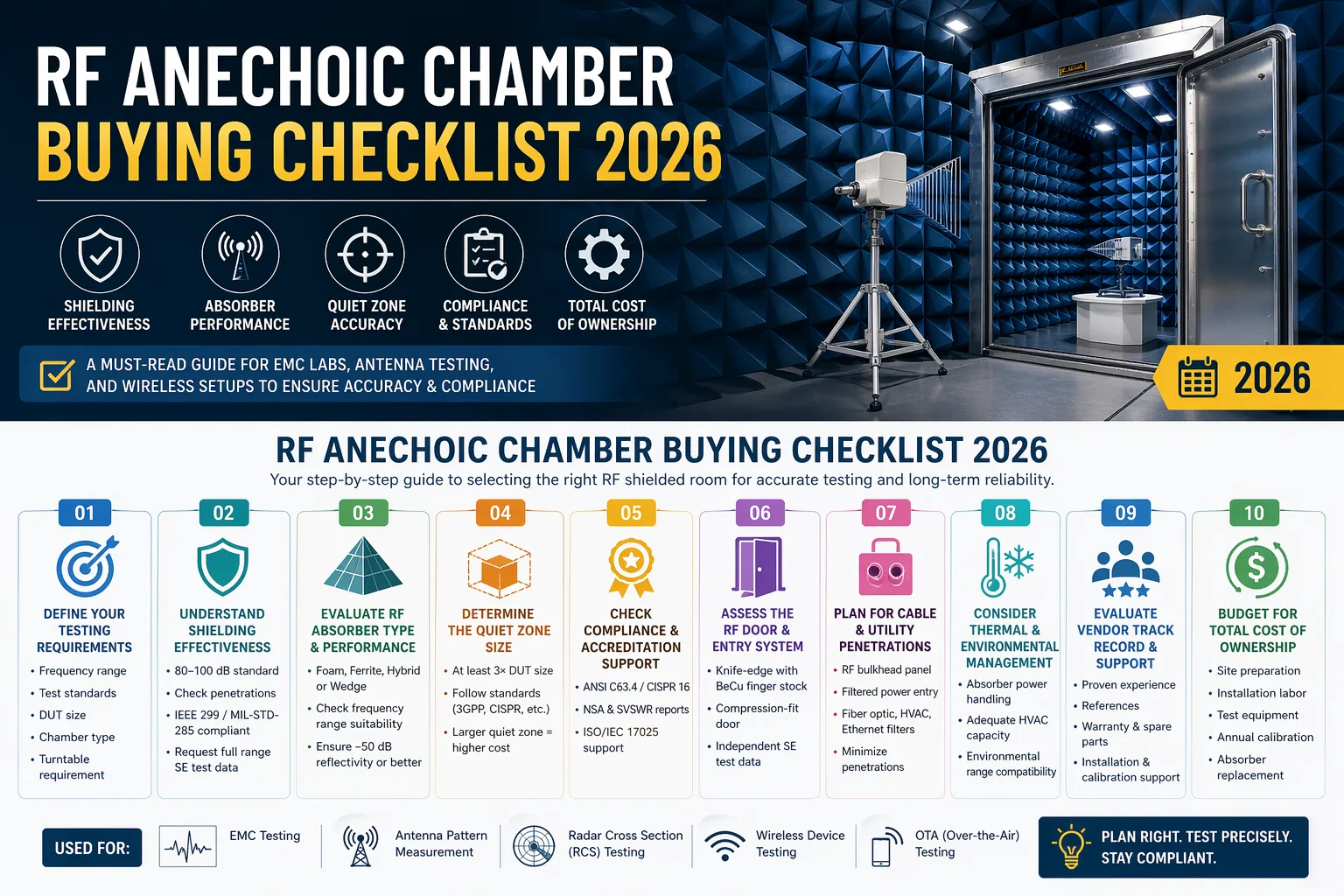
Check Compliance and Accreditation Support
Your chamber needs to support certification testing, which means it must be calibrated, validated, and potentially accredited.
Checklist items:
- Does the chamber meet the site validation requirements of ANSI C63.4, CISPR 16-1-4, or 3GPP TS 38.903 as applicable?
- Can the vendor provide a normalized site attenuation (NSA) measurement report?
- Does the chamber design support ISO/IEC 17025 accreditation requirements?
- Is a site voltage standing wave ratio (SVSWR) measurement protocol supported?
Assess the RF Door and Shielded Entry System
The RF door is the single most failure-prone component in any shielded chamber. A poorly designed door degrades shielding effectiveness over time.
What to look for:
- Knife-edge contact doors with beryllium copper (BeCu) finger stock offer the best long-term SE performance.
- Compression-fit doors (pneumatic or cam-lock) are suitable for most commercial labs.
- Verify the door's SE is independently tested - not just the room walls.
- Ask about door maintenance schedules and replacement finger stock availability.
Plan for Cable and Utility Penetrations
Every penetration is a potential breach in shielding. A professional chamber design minimizes penetrations while accommodating your measurement needs.
Penetration checklist:
- RF bulkhead panel with appropriate connector types (N, SMA, Type-N, waveguide, etc.)
- Low-pass filtered AC power entry for powering DUTs and equipment inside the chamber
- Fiber optic penetrations for signal control without RF leakage
- HVAC penetration with cutoff waveguide - critically important for thermal management without compromising SE
- Ethernet/data penetrations with proper filtering
Consider Thermal and Environmental Management
RF absorbers generate heat under high-power testing. The chamber environment must be controlled to protect both equipment and measurement accuracy.
- Specify maximum power handling of absorbers (watts per panel).
- Ensure HVAC capacity matches the thermal load of your amplifiers and DUT.
- For environmental chambers integrated with anechoic testing (e.g., automotive radar under temperature extremes), verify temperature range compatibility.
Evaluate the Vendor's Track Record and Support
An anechoic chamber is not a commodity purchase. Choose a vendor with proven experience.
Vendor evaluation checklist:
- How many chambers has the vendor built for similar applications?
- Can they provide references from labs with comparable frequency ranges and test standards?
- What is the warranty period on shielding and absorbers?
- Do they offer on-site installation, calibration, and validation?
- What is their turnaround time for spare parts (especially door finger stock)?
- Is remote diagnostics or troubleshooting support available?
Budget for the Total Cost of Ownership
The purchase price is only part of the story. Factor in:
- Site preparation - concrete floors, reinforcement for chamber weight, HVAC modifications
- Installation labor - typically 20-40% of chamber cost for large facilities
- Test equipment - signal analyzers, network analyzers, amplifiers, positioners, and software
- Annual calibration and site validation - typically $10,000-$30,000/year for accredited labs
- Absorber replacement - foam absorbers degrade over 10-15 years
Leave a Reply