Are RF Absorbers Necessary for Testing Labs?
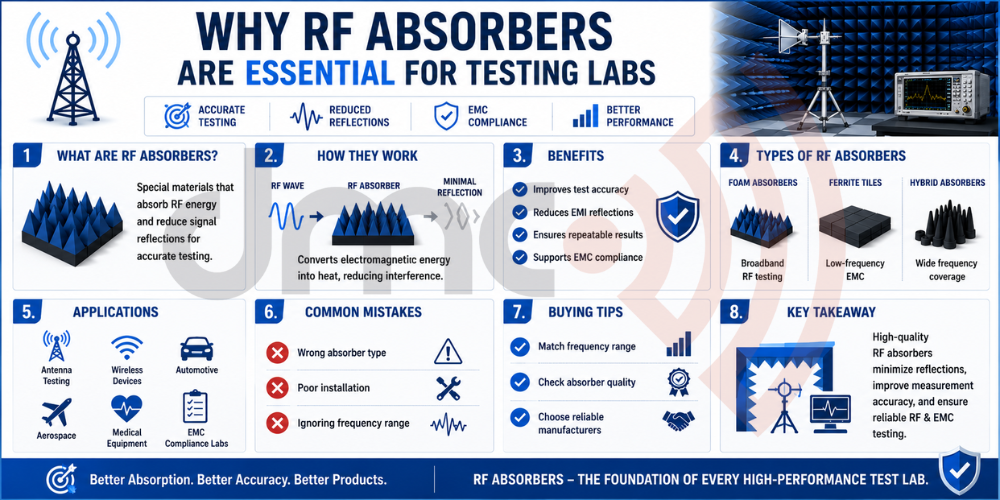
Table of Contents
As wireless communication technologies continue to evolve, testing laboratories are expected to deliver highly accurate and repeatable measurement results. Whether evaluating antennas, wireless devices, radar systems, automotive electronics, or aerospace components, the testing environment plays a critical role in ensuring reliable data.
One of the most important components inside an RF or EMC testing facility is the RF absorber. These specially engineered materials are designed to absorb electromagnetic waves instead of reflecting them, creating a controlled environment for precise testing.
But are RF absorbers truly necessary for every testing lab? The answer is yes for most RF and EMC applications. Without them, unwanted reflections and interference can significantly affect measurement accuracy, leading to unreliable test results and costly product redesigns.
This guide explains what RF absorbers are, why they matter, and how they contribute to high-quality testing.
What Are RF Absorbers?
RF absorbers are materials specifically designed to reduce or eliminate reflected radio frequency energy inside testing environments. Instead of allowing electromagnetic waves to bounce off walls, ceilings, or floors, absorbers convert RF energy into a small amount of heat.
These absorbers are commonly installed in:
- RF Anechoic Chambers
- EMC Chambers
- Shielded Rooms
- Antenna Testing Facilities
- OTA Testing Labs
- Radar Testing Facilities
- Research Laboratories
By minimizing reflections, RF absorbers help simulate free-space conditions, making measurements more accurate and repeatable.
Why Testing Labs Need RF Absorbers
Testing laboratories rely on controlled environments to evaluate the true performance of electronic devices.
Without RF absorbers:
- Signal reflections distort measurements.
- Antenna radiation patterns become inaccurate.
- Spectrum analyzer readings fluctuate.
- Wireless performance tests lose repeatability.
- External noise affects sensitive equipment.
- Compliance testing becomes unreliable.
RF absorbers create an environment where engineers can measure only the device under test, not unwanted reflections.
How RF Absorbers Improve Measurement Accuracy
Measurement accuracy is the foundation of every testing laboratory.
RF absorbers improve testing by:
- Reducing multipath reflections
- Improving signal clarity
- Increasing repeatability
- Creating stable testing conditions
- Minimizing standing waves
- Lowering measurement uncertainty
The result is more consistent data that engineers can trust during product development and certification.
Types of RF Absorbers Used in Testing Labs
Different testing applications require different absorber designs.
| RF Absorber Type | Typical Application | Key Benefit |
|---|---|---|
| Pyramidal Absorbers | RF Anechoic Chambers | Excellent Broadband Absorption |
| Ferrite Tile Absorbers | EMC Chambers | Effective at Lower Frequencies |
| Hybrid Absorbers | EMC Compliance Labs | Wide Frequency Coverage |
| Foam RF Absorbers | General RF Testing | Lightweight and Cost-Effective |
| High-Power RF Absorbers | Defense & Radar Labs | Handles High RF Energy Safely |
Selecting the appropriate absorber depends on the frequency range, chamber size, and testing requirements.
Applications of RF Absorbers
Applications of RF Absorbers
RF absorbers are widely used across industries, including:
- Antenna testing
- 5G and 6G research
- Automotive radar validation
- Aerospace and defense testing
- Satellite communication systems
- Wireless device development
- Medical electronics
- Industrial automation
- IoT product testing
- University research laboratories
Their versatility makes them an essential component in modern RF infrastructure.
Benefits of Installing RF Absorbers
Installing high-quality RF absorbers offers several advantages:
- Improved measurement accuracy
- Better repeatability
- Reduced electromagnetic reflections
- Enhanced chamber performance
- Faster product development
- Reliable compliance testing
- Lower risk of failed certification
- Increased customer confidence
- Long-term operational reliability
For laboratories performing precision measurements, these benefits often outweigh the initial investment.
How to Choose the Right RF Absorber
When selecting RF absorbers, consider:
- Operating frequency range
- Chamber dimensions
- Required reflectivity levels
- Power handling capability
- Environmental conditions
- Compliance standards
- Installation method
- Future testing needs
Working with experienced chamber manufacturers can help ensure the absorber system matches your laboratory requirements.
Common Mistakes to Avoid
Many organizations reduce testing accuracy by making avoidable mistakes, such as:
- Choosing absorbers only based on price
- Ignoring frequency performance
- Mixing incompatible absorber types
- Poor installation practices
- Delaying replacement of damaged absorbers
- Neglecting periodic chamber inspections
Routine maintenance and proper absorber selection help maintain reliable testing conditions.
Pro Tip
Inspect RF absorbers regularly for wear, moisture, dust buildup, or physical damage. Even small defects can increase signal reflections and affect measurement accuracy. Replacing damaged absorbers promptly helps maintain consistent and reliable test results over time.
Conclusion
RF absorbers are far more than accessories—they are a fundamental part of accurate RF and EMC testing environments. By minimizing unwanted reflections and creating controlled electromagnetic conditions, they enable laboratories to perform reliable measurements, improve product quality, and support successful compliance testing.
Whether your laboratory focuses on antenna development, wireless communication, automotive electronics, aerospace systems, or EMC certification, investing in the right RF absorber solution enhances measurement confidence and long-term testing performance.
Leave a Reply