Best Place to Buy RF Absorbers Online

Table of Contents
- What Are RF Absorbers?
- Key Factors to Consider When Buying RF Absorbers Online
- Where to Buy RF Absorbers Online
- What to Avoid When Buying RF Absorbers Online
Whether you're designing an anechoic chamber, testing antenna performance, or shielding sensitive electronics from electromagnetic interference (EMI), RF absorbers are a non-negotiable part of your toolkit. But with dozens of suppliers scattered across the internet, finding a reliable source - one that combines technical expertise, product quality, and responsive support - can be surprisingly difficult.
This guide walks you through everything you need to know before buying RF absorbers online: what to look for, which types suit your application, and where the most trusted suppliers are.
What Are RF Absorbers?
RF (Radio Frequency) absorbers are materials engineered to attenuate or eliminate electromagnetic waves, typically by converting RF energy into heat. They are used across a broad range of industries, including:
- Telecommunications: reducing signal reflections in antenna test facilities
- Aerospace & Defence: stealth technology and radar cross-section (RCS) testing
- Automotive: EMC compliance testing for connected and autonomous vehicles
- Medical devices: ensuring that equipment meets strict electromagnetic compatibility (EMC) standards
- Consumer electronics: minimising interference in compact device designs
RF absorbers come in various shapes and configurations - pyramidal foam tiles, flat sheets, honeycomb panels, and flexible rubberised rolls - and selecting the right one depends heavily on your operating frequency range, space constraints, and performance targets.
Key Factors to Consider When Buying RF Absorbers Online
Before placing an order, ask yourself the following questions:
1. What frequency range do I need?
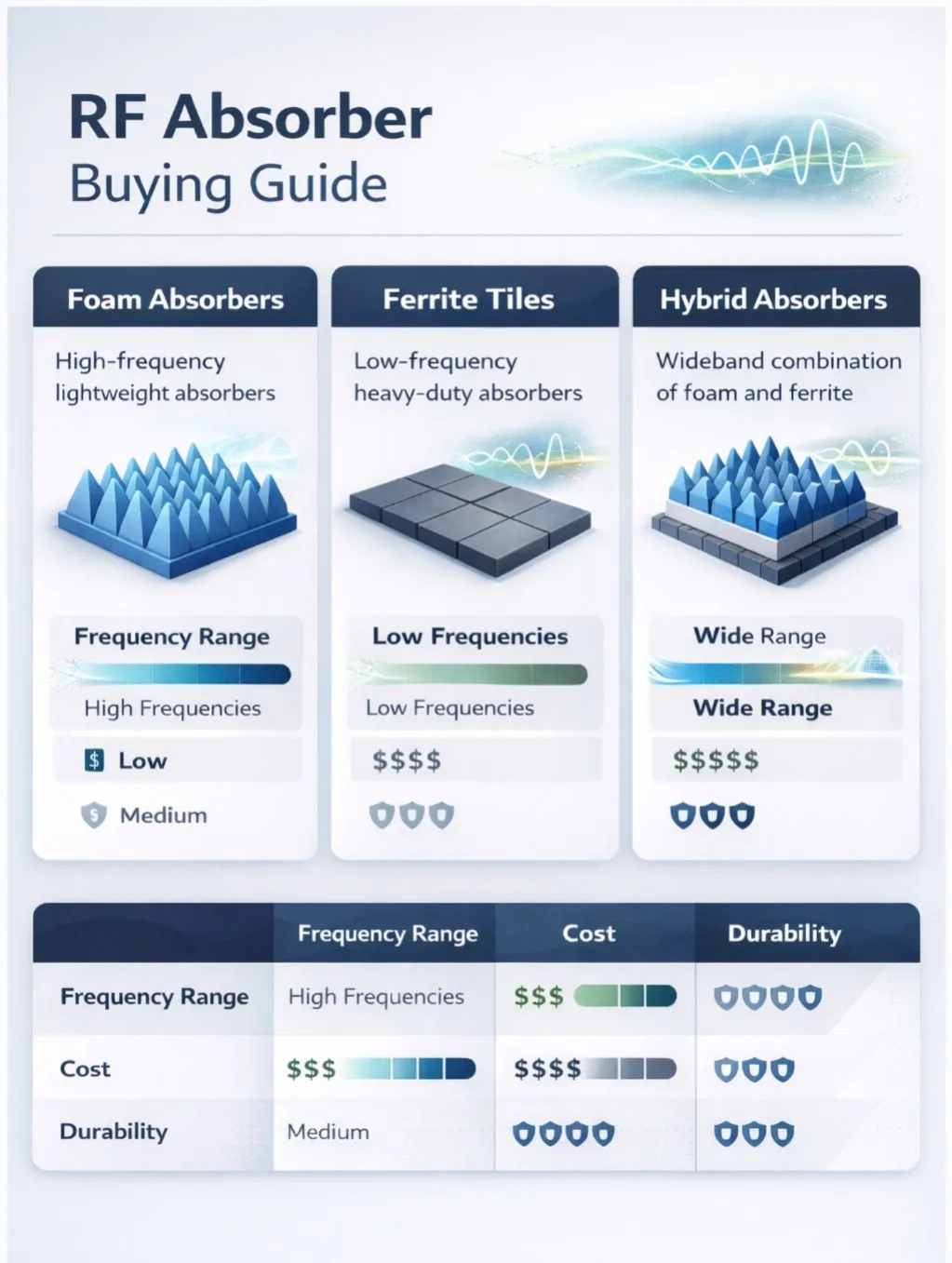
Absorbers are not one-size-fits-all. Pyramidal absorbers typically perform well from 1 GHz upwards, while hybrid or ferrite-loaded designs may be necessary for lower frequencies (below 1 GHz). Always check the attenuation curve across your target frequency band.
2. What level of reflectivity is acceptable?
Measured in dB, reflectivity tells you how much energy bounces back. High-performance anechoic chambers may require -40 dB or better, while industrial shielding enclosures might work fine with -20 dB.
3. What are the environmental conditions?
Temperature, humidity, flammability regulations, and mechanical stress all influence which material you should select. Many facilities require materials with specific fire ratings (e.g., UL 94 or EN 13501).
4. Do I need custom sizes or shapes?
Off-the-shelf products may not fit bespoke test enclosures or chambers. Suppliers offering custom fabrication are significantly more valuable for professional projects.
5. Is there technical support available?
RF engineering is specialist territory. A supplier who can advise on placement, panel orientation, and performance optimisation is worth far more than the cheapest listing on a generic marketplace.
Types of RF Absorbers: At a Glance
| Type | Frequency Range | Best For | Form Factor |
|---|---|---|---|
| Pyramidal Foam | 1 GHz - 40+ GHz | Anechoic chambers, antenna testing | Foam tiles with pointed peaks |
| Flat Foam (Urethane) | 3 GHz - 40+ GHz | Compact enclosures, PCB testing | Thin flat sheets |
| Ferrite Tile | 30 MHz - 1 GHz | Semi-anechoic chambers, EMC labs | Rigid ceramic-like tiles |
| Hybrid (Ferrite + Foam) | 30 MHz - 18 GHz | Full-range EMC compliance testing | Layered panel construction |
| Flexible/Rubber Absorbers | 1 GHz - 18 GHz | Curved surfaces, retrofit installs | Roll or sheet format |
| Wedge/Convoluted Foam | 500 MHz - 40+ GHz | High-performance chambers | Wedge-shaped foam tiles |
Where to Buy RF Absorbers Online
When sourcing RF absorbers online, you want a supplier that offers more than just a product catalogue - you need technical credibility, reliable lead times, and the ability to handle both small orders and large-scale chamber builds.
Diamond Microwave Chambers Ltd - A Leading Choice
One of the most respected names in the industry is Diamond Microwave Chambers Ltd, a USA-based specialist with deep expertise in RF absorber materials and anechoic chamber solutions.
What sets Diamond Microwave Chambers apart is their end-to-end capability. They don't just sell absorbers - they understand how absorbers function within a complete RF test environment. Their product range covers pyramidal absorbers, flat panel absorbers, and hybrid solutions suitable for both commercial EMC compliance labs and high-performance defence-grade facilities.
Their team includes RF engineers who can assist with chamber design, absorber selection based on your specific frequency requirements, and performance modelling - a level of support you simply won't find with generic online retailers. For organisations building or upgrading anechoic chambers, this consultative approach is invaluable.
DMC serves clients across the USA, Europe, and internationally, making them a go-to partner for both one-off purchases and full chamber fit-outs.
What to Avoid When Buying RF Absorbers Online
- Generic marketplaces without technical specs - Listings on platforms like Alibaba or eBay often lack the material data sheets, reflectivity curves, or fire certifications you need for professional use.
- No return or exchange policy - RF absorbers are precision materials. If a batch doesn't meet spec, you need recourse.
- Suppliers with no RF engineering background - An RF absorber is only as good as its application. A supplier that can't advise on placement or panel orientation could cost you more in re-testing than you saved on price.
- Missing certifications - For regulated environments (especially medical, defence, or automotive testing), ensure products comply with relevant fire, material safety, and EMC standards.
Pro Tip
Always request a reflectivity curve (not just a peak dB figure) before purchasing. A supplier quoting "-40 dB reflectivity" without specifying the frequency at which that figure is achieved is presenting incomplete data. A full reflectivity-vs-frequency curve allows you to verify performance across your entire operating band, not just at the ideal test point. Reputable suppliers like Diamond Microwave Chambers Ltd provide this data as standard - if a vendor can't or won't share it, that's a red flag.
Making the Right Decision
Buying RF absorbers online doesn't have to be a gamble. The key is to treat your purchase as a technical procurement decision, not a commodity order. Gather specifications, ask for test data, verify certifications, and work with suppliers who have a demonstrated track record in RF engineering environments.
For most professional buyers - whether you're outfitting an EMC lab, upgrading an anechoic chamber, or sourcing materials for a defence contract - working with an established specialist like Diamond Microwave Chambers Ltd offers the best combination of product quality, technical support, and long-term reliability.
Take the time to brief your supplier properly, and the right RF absorber solution will pay dividends in consistent, accurate test results for years to come.
Leave a Reply