What Is the Difference Between RF and EMC Chambers?
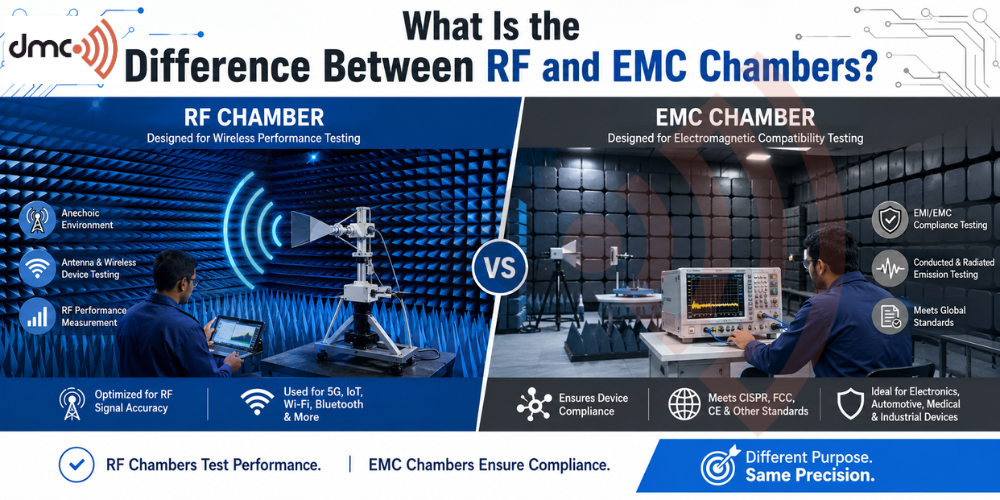
Table of Contents
When people hear the terms RF Chamber and EMC Chamber, they often assume they are the same because both are enclosed testing environments designed to isolate electromagnetic signals. While they share certain similarities, they are built for different purposes and are used in different stages of product development and certification.
Understanding the difference between these two chambers is essential for engineers, manufacturers, research laboratories, defense organizations, automotive companies, aerospace industries, and telecommunications businesses. Choosing the wrong testing environment can lead to inaccurate measurements, failed compliance tests, project delays, and unnecessary costs.
This guide explains what RF and EMC chambers are, how they work, where they differ, and which one is suitable for your application.
What Is an RF Chamber?
An RF (Radio Frequency) Chamber is a specially designed enclosure that creates a controlled environment for radio frequency testing. These chambers prevent unwanted external signals from entering while also stopping internal signals from escaping.
The walls are lined with RF absorbers that minimize reflections and simulate free-space conditions. This enables engineers to evaluate antennas, wireless communication devices, radar systems, satellite equipment, and other RF components with high accuracy.
Typical RF chamber applications include:
- Antenna radiation pattern measurements
- Antenna gain testing
- OTA (Over-the-Air) testing
- Wireless device validation
- Radar system development
- 5G and Wi-Fi testing
- Microwave component testing
The primary objective of an RF chamber is measurement accuracy by reducing signal reflections.
What Is an EMC Chamber?
An EMC (Electromagnetic Compatibility) Chamber is designed to verify whether electronic equipment meets international electromagnetic compatibility standards.
Instead of focusing only on radio performance, EMC chambers evaluate whether a device:
- Emits excessive electromagnetic interference (EMI)
- Can withstand electromagnetic disturbances
- Operates correctly in noisy electromagnetic environments
Manufacturers use EMC chambers before product certification to comply with regulations such as:
- CISPR
- IEC
- MIL-STD
- FCC
- CE Requirements
- ISO Automotive Standards
EMC testing is mandatory for many commercial electronic products before they can enter global markets.
Main Purpose of RF Chambers
RF chambers help engineers achieve precise wireless measurements by eliminating signal reflections.
Typical objectives include:
- Antenna characterization
- Beamforming verification
- Gain measurements
- Signal strength evaluation
- Frequency response testing
- Communication range testing
The chamber behaves almost like an open outdoor environment without external interference.
Main Purpose of EMC Chambers
EMC chambers focus on regulatory compliance and product reliability.
Engineers perform tests such as:
- Radiated emissions
- Conducted emissions
- Radiated immunity
- Conducted immunity
- ESD testing
- Surge testing
- EFT testing
The goal is ensuring products neither create nor suffer from electromagnetic interference.
RF Chamber vs EMC Chamber Comparison
| Feature | RF Chamber | EMC Chamber |
|---|---|---|
| Primary Purpose | RF Performance Testing | EMC Compliance Testing |
| Main Focus | Wireless Signal Measurements | Electromagnetic Compatibility |
| Reflection Control | Extremely High | Moderate to High |
| RF Absorbers | Full Absorber Lining | Hybrid Absorbers |
| Shielding | Very High | Very High |
| Common Tests | OTA, Antenna, Radar | EMI, EMS, Compliance |
| Industries | Telecom, Aerospace, Defense | Consumer Electronics, Automotive, Medical |
| Certification | Usually R&D | Regulatory Compliance |
| Measurement Goal | Accurate RF Performance | Standard Compliance |
| Cost | Often Higher for Precision | Depends on Chamber Size and Standards |
Construction Differences
Although both chambers use shielding, their internal construction differs significantly.
RF Chambers
RF chambers typically include:
- Full pyramidal RF absorbers
- High-performance shielding
- Precision turntables
- Antenna positioning systems
- Low-reflection floor treatments
- Quiet Zone optimization
The goal is to minimize reflected signals.
EMC Chambers
EMC chambers often include:
- Ferrite tiles
- Hybrid absorbers
- Conductive ground plane
- Test tables
- EMC antennas
- Measurement receivers
These chambers are optimized for compliance testing rather than radiation pattern measurements.
Industries That Use RF Chambers
Many industries depend on RF chambers for research and product development.
Examples include:
- Aerospace
- Defense
- Telecommunications
- Satellite Communication
- Automotive Radar
- IoT Manufacturers
- Research Laboratories
- Universities
Industries That Use EMC Chambers
EMC chambers are widely used wherever electronic products require certification.
Common industries include:
- Medical equipment
- Automotive
- Consumer electronics
- Industrial automation
- Railway electronics
- Defense electronics
- Household appliances
- Renewable energy systems
Can One Chamber Replace the Other?
This is one of the most common questions.
The answer is not always.
While some hybrid chambers support limited RF and EMC testing, a dedicated RF chamber cannot fully replace an EMC chamber for certification testing. Likewise, an EMC chamber is not optimized for high-precision antenna measurements.
Organizations with both R&D and compliance requirements often install separate chambers for each purpose.
How to Choose the Right Chamber
Before investing, consider these questions:
- What type of testing will you perform most frequently?
- Do you require international certification?
- Are you testing antennas or complete electronic products?
- What frequency range is required?
- What level of measurement accuracy is needed?
- Is future expansion planned?
- Will the chamber support multiple industries?
Answering these questions helps determine whether an RF chamber, EMC chamber, or hybrid solution best fits your needs.
Benefits of Using the Correct Chamber
Selecting the appropriate chamber offers several advantages:
- Higher testing accuracy
- Faster product development
- Reduced retesting costs
- Easier regulatory approval
- Improved product reliability
- Better customer confidence
- Reduced electromagnetic interference
- More consistent measurement results
Pro Tip
If your organization develops wireless communication products and needs regulatory certification, consider planning separate RF and EMC testing capabilities early in the project. Designing products with both performance and compliance in mind can significantly reduce redesign efforts, shorten development cycles, and improve first-pass test success.
Conclusion
Although RF and EMC chambers appear similar from the outside, they serve very different purposes. RF chambers are built to deliver highly accurate radio frequency measurements by creating a reflection-free environment, making them ideal for antenna, wireless, and radar testing. EMC chambers, on the other hand, are designed to verify that electronic products meet electromagnetic compatibility requirements by measuring emissions and immunity according to international standards.
Understanding these differences helps engineers, manufacturers, and testing laboratories select the right chamber for their specific application. Choosing the appropriate testing environment not only improves measurement accuracy but also reduces development time, minimizes compliance risks, and supports the successful launch of reliable, high-quality electronic products.
Leave a Reply