RF Absorbers Buying Guide for First-Time Buyers
Table of Contents
- What Are RF Absorbers?
- Why RF Absorbers Are Important
- Important Factors to Consider When Choosing the Correct RF Absorber
- Application Areas of RF Absorbers
The RF absorbers are important components that are used in electronic devices, telecommunication networks, aerospace, automobile testing facilities, and military installations. The RF absorbers control the electromagnetic waves by reducing reflection and interference. It does not matter whether you require an anechoic chamber layout, precise EMC testing, or reduce noise from the signals; choosing the right RF absorbers is essential.
If you are a novice using the RF absorbers, you might feel that buying the RF absorbers is a complex task due to many types available. The RF absorbers buying guide below highlights some basic concepts about RF absorbers for beginners.
What Are RF Absorbers?
RF absorbers are unique electromagnetic energy absorbers designed to absorb radio frequencies rather than reflect them. The purpose of such absorbers is to turn the absorbed RF energy into some heat.
The applications of RF absorbers include but are not limited to:
- Anechoic chambers
- EMC and EMI testing facilities
- Wireless communications systems
- Radar and satellite testing equipment
- Electronic equipment test facilities for automotive industry
- Aerospace and military products
- Test equipment for 5G and IoT device
In absence of sufficient RF absorption, reflected RF signals might distort the results of tests conducted.
Why RF Absorbers Are Important
Today's electronic equipment works in environments that are saturated with electromagnetic radiation. Reflections could cause electromagnetic interference, poor wireless reception, and measurement errors.
The use of RF absorbers would:
- Minimize signal reflection
- Maintain EMC requirements
- Facilitate effective antenna measurements
- Provide accurate test results
- Create EMI shielding materials
- Contribute to better wireless reception
It is for these reasons that RF absorbers are important in professional RF testing applications.
Some of the Common RF Absorber Types
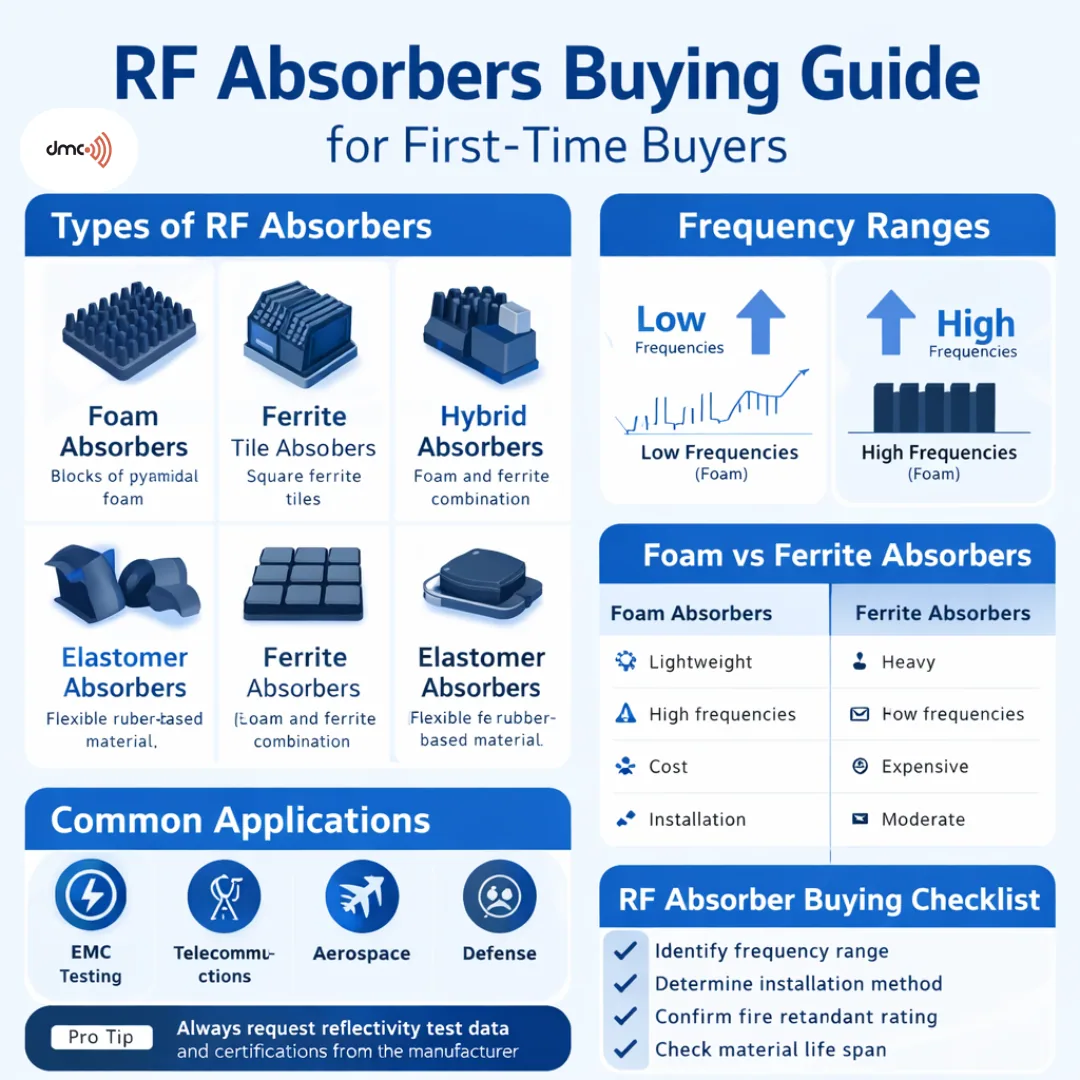
Type of RF Absorber Material Application:
Foam RF Absorbers
RF absorbing foams are widely used in anechoic chambers and high-frequency testing applications. Such absorbers are low weight and affordable and thus are ideal for microwave absorbers.
Suitable for:
- Antenna testing
- Microwave testing
- High-frequency chambers
Ferrite Tile Absorbers
These are suitable for the control of low-frequency electromagnetic waves. They act as good absorbers for EMC testing chambers because of their excellent absorption of low frequencies.
Suitable for:
- Electromagnetic compatibility testing chamber
- Automotive electronics
- Tests of industrial equipment
Hybrid RF Absorbers
Hybrid absorbers combine ferrite tiles and foam absorbers to provide broad frequency bands.
For:
- General RF testing purposes
- Multiband testing
- Advanced EMC test rooms
Elastomer Absorbers
Elastomers are resilient absorbers and suitable for rough industrial applications.
For:
- Outdoor electronics
- Industrially tough RF systems
- Small electronics parts
Aspects to Consider During Purchase of Absorbers
Apart from other aspects to consider, one of the key aspects when purchasing RF absorbers is frequency.
Low Frequency Absorption
Absorption of low frequencies is difficult and calls for ferrite tile absorbers or Hybrid absorbers.
For:
- Tests for electromagnetic compatibility
- Vehicle electronics
- Generic tests in industries
High Frequency Absorption
Foam absorbers are very effective in absorbing high frequency microwaves and millimeter waves.
For:
- Radar applications
- Satellite communication
- 5G testing purposes
- Aerospace electronic testing equipment
Wideband Applications
If more than one frequency range is considered, hybrid absorbers must be used to ensure proper performance at both high and low frequency ranges.
Important Factors to Consider When Choosing the Correct RF Absorber
1. Application
The first thing to consider when choosing an RF absorber is the purpose for which it is needed.
Some of the questions you need to ask yourself include:
- What purpose does the absorber serve?
- Is it needed to prevent EMI?
- Does it have any outdoor or indoor use?
- Is it required for permanent installation?
Depending on your needs, you can easily find a suitable material and design.
2. Reflectivity
Reflectivity values should be provided by all manufacturers.
Examples include:
- -10 dB: 90% attenuation
- -20 dB: 99% attenuation
- -30 dB: 99.9% attenuation
A lower reflectivity implies that an absorber is more efficient.
3. Design
Several different design approaches can be found in RF absorbers, which include:
- Pyramidal shape
- Wedge shape
- Sheet form
- Tiled form
- Convoluted foam
All designs are prevalent; however, pyramidal absorbers are the most frequently used.
4. Environmental Exposure
Some environmental factors like temperature, humidity, and flame resistance may affect the absorbers. They include:
- Temperature resistant
- Humidity resistant
- High fire resistance
- Solar resistant
- Mechanical resistance
Absorbers that resist the environment are the best options for outdoor usage.
5. Methods of Installation
Some absorbers have adhesive backing while others come with installation kits.
Be careful about:
- Wall compatible
- Ceiling compatible
- Maintenance availability
- Replaceability convenience
Application Areas of RF Absorbers
There are various applications of RF absorbers owing to advancements in technology used in wireless devices.
Echo Free Chambers
In this case, absorbers installed in anechoic chambers block any reflections and create a controlled environment for testing antennas and electromagnetic compatibility.
Telecommunications
RF absorbers are used in wireless telecommunication systems to enhance the quality of signals and reduce electromagnetic interference.
Military and Aerospace Industry
The best quality absorbers are used in military radar and aerospace systems.
Automotive Testing
Modern automobiles require electronic compatibility tests via RF absorbers since they consist of modern electronics.
Mistakes to Make While Buying
Below are some mistakes one should not make when buying RF absorbers for the first time. Disregarding Frequency Requirements
Disregarding Frequency Requirements
Operation of absorbers outside the frequencies leads to inaccurate tests. Purchase of Generic Absorber Foam Materials
All foam absorber materials should be certified RF absorbers. Neglecting Important Safety Standards
Some facilities may need absorber materials that are fire-resistant.
- Miscalculation of room dimensions
- For efficient utilization, the room should have sufficient size.
- Choosing the right supplier is as critical as the selection of absorbers.
Choose Suppliers Who Provide
- Tech advisory
- Reflectivity test results
- EMC compliance
- Manufacturing customization
- Installation assistance
- Warranties
A professional supplier will guide novice buyers in avoiding mistakes that may cost them dearly and choosing the right RF absorbers.
Buying RF absorbers for novices need not necessarily be a hard task. After gathering all the information regarding various types of absorbers, frequencies, and the installation conditions among others, buying the RF absorbers will become an easy task.
Selecting the right RF absorber for you will always depend on you personally because of the application, performance, and your budget. Do not be concerned with price alone; be more concerned about the performance of the absorbers. The right RF absorbers will ensure accuracy in testing while minimizing EMI.
Leave a Reply