RF Chamber Suppliers: How to Choose the Best
Table of Contents
- Why Supplier Selection Matters More Than You Think
- 1. Check Real Experience, Not Just Marketing Claims
Choosing the right RF chamber suppliers is not just about comparing prices or picking the most popular name. An RF chamber is a long-term investment that directly affects testing accuracy, compliance, and overall product reliability. Whether you're setting up an EMI/EMC lab, upgrading your testing facility, or building a research environment, your supplier choice can make or break the entire setup.
Many buyers focus heavily on equipment specifications but overlook the supplier's expertise, installation quality, and after-sales support. That's where problems usually begin.
Let's walk through the key factors you should consider before finalizing an RF chamber supplier-explained in a practical, real-world way.
Why Supplier Selection Matters More Than You Think
An RF chamber is not a simple off-the-shelf product. It involves:
- Structural design
- RF absorber integration
- Shielding performance
- Ventilation and power management
A supplier who lacks experience may deliver a technically "complete" system that still fails during real testing conditions.
In many cases, the difference between accurate and inconsistent results comes down to how well the chamber is designed and installed-not just the materials used.
1. Check Real Experience, Not Just Marketing Claims
Many RF chamber suppliers showcase impressive portfolios, but you need to verify actual project experience.
Look for:
- Completed EMI/EMC labs
- Industry-specific projects (defense, telecom, automotive)
- Client references or case studies
Suppliers with hands-on experience understand practical challenges like leakage issues, grounding problems, and absorber placement.
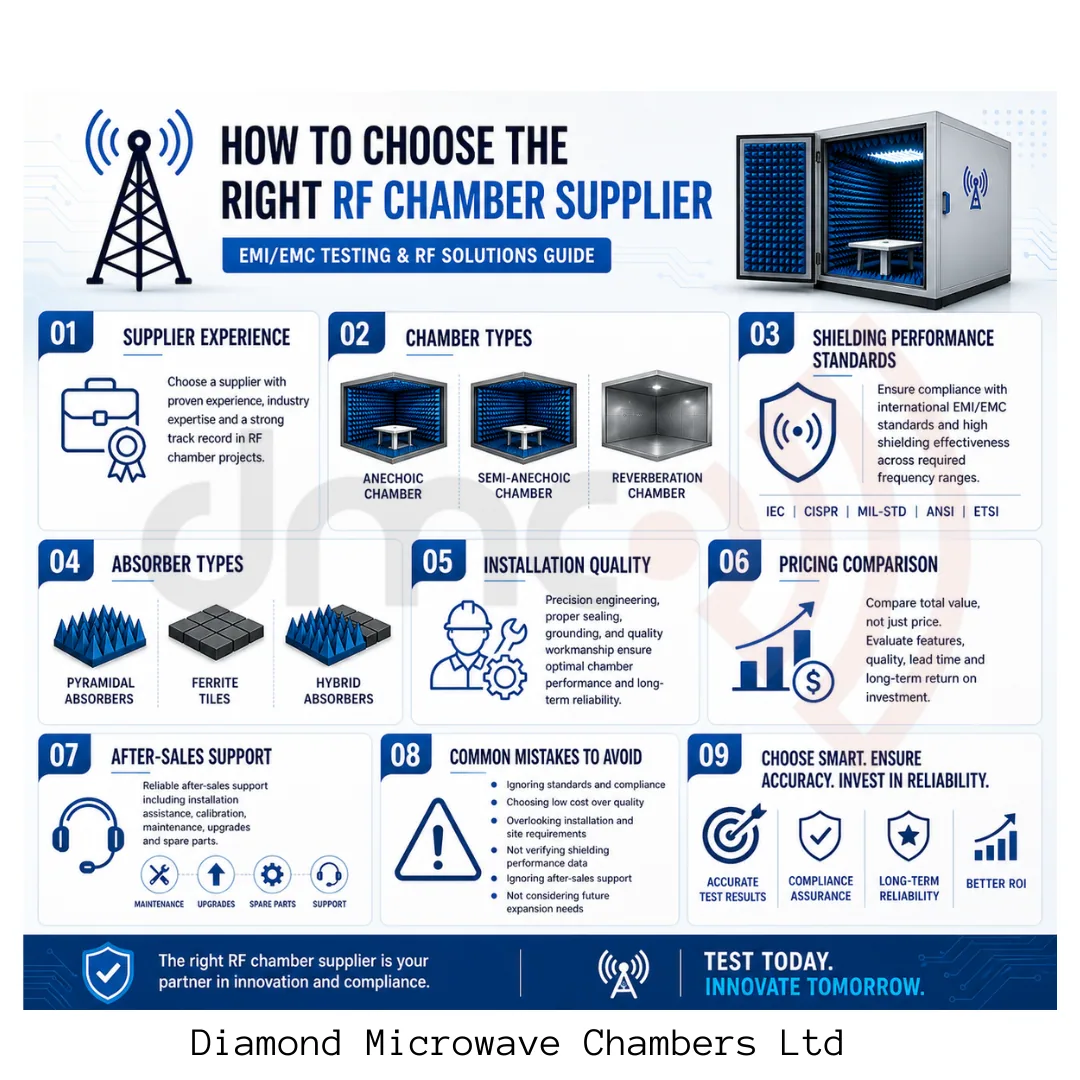
2. Understand the Type of RF Chamber You Need
Not all chambers are the same. Choosing the wrong type can lead to poor test results.
Common Types:
- Anechoic Chambers -> For radiation and antenna testing
- Semi-Anechoic Chambers -> For EMI/EMC compliance testing
- Reverberation Chambers -> For high-frequency testing
A good supplier will help you match your application with the right chamber type instead of pushing a one-size-fits-all solution.
3. Evaluate Shielding Performance and Standards
Shielding effectiveness is a critical factor.
Ask suppliers:
- What shielding levels are guaranteed?
- Which standards are followed?
- Are test reports available?
Typical standards include:
- EMI/EMC compliance
- Military standards (MIL-STD)
- ISO certifications
Without proper validation, even a high-cost chamber can fail compliance testing.
4. Pay Attention to RF Absorber Quality
Absorbers play a major role in controlling reflections inside the chamber.
Types of Absorbers:
- Pyramidal foam absorbers
- Ferrite tile absorbers
- Hybrid absorbers
Low-quality absorbers can:
- Degrade quickly
- Reduce measurement accuracy
- Increase maintenance costs
Always ask about absorber lifespan and performance across frequency ranges.
5. Installation Expertise Is Critical
Even a perfectly designed chamber can underperform if installation is poor.
Common issues include:
- Improper panel alignment
- Leakage at joints
- Poor grounding
A reliable RF chamber supplier will provide:
- Professional installation
- On-site testing
- Calibration support
Skipping this step is one of the biggest mistakes buyers make.
6. Compare Pricing the Right Way
Price comparison should not be based only on the total cost.
Break it down into:
- Material quality
- Absorber type
- Installation charges
- Testing and certification
- After-sales support
A lower quote often means compromises somewhere-usually in materials or service.
Comparison Table: What to Check in RF Chamber Suppliers
| Factor | What to Look For | Red Flag to Avoid |
|---|---|---|
| Experience | Proven projects, case studies | No real references |
| Shielding Quality | Verified test reports | No certification data |
| Absorbers | High-quality, tested materials | Cheap, unverified foam |
| Installation | Professional setup + testing | DIY or outsourced installation |
| Support | Ongoing technical assistance | No after-sales service |
| Pricing | Transparent breakdown | Hidden or unclear costs |
7. Customization Capability Is a Must
Every lab or facility has unique requirements.
You may need:
- Custom chamber sizes
- Special door configurations
- Cable entry panels
- Ventilation systems
Suppliers who only offer standard models may not meet your exact needs.
8. Check After-Sales Support and Maintenance
An RF chamber is not a one-time purchase-it requires maintenance.
Ensure the supplier offers:
- Periodic inspection
- Absorber replacement
- Technical troubleshooting
Without support, even a high-quality chamber can lose effectiveness over time.
9. Location and Accessibility Matter
Choosing RF chamber suppliers within India can provide advantages like:
- Faster installation
- Lower logistics cost
- Quick service support
For businesses in cities like Chennai, Bangalore, or Hyderabad, local suppliers can significantly reduce downtime during maintenance or upgrades.
10. Look for Transparency and Communication
A trustworthy supplier will:
- Explain technical details clearly
- Provide realistic timelines
- Share limitations upfront
If a supplier promises "perfect results" without discussing challenges, that's usually a warning sign.
Pro Tip
Before finalizing any RF chamber supplier, visit an existing installation or request a live demo.
Seeing a real working setup helps you evaluate:
- Build quality
- Noise levels
- Overall performance
This step alone can prevent costly mistakes.
Common Mistakes Buyers Make
Let's be honest-most issues arise from avoidable mistakes:
- Choosing based only on price
- Ignoring installation quality
- Not verifying certifications
- Skipping real-world testing
- Overlooking after-sales support
Avoiding these can save both time and money.
Selecting the right RF chamber supplier is a strategic decision, not just a purchase.
The best supplier is not the cheapest or the most advertised-it's the one who:
- Understands your application
- Provides reliable performance
- Supports you after installation
Take time to evaluate properly, ask the right questions, and prioritize long-term value over short-term savings.
Leave a Reply