Top Tips Before Purchasing RF Shielding Solutions
Table of Contents
- Start With the Actual Problem, Not the Product
- Installation Can Make or Break Performance
- Quick Comparison of Common RF Shielding Materials
When people first explore RF shielding solutions, they often assume it's simply about blocking unwanted signals. In reality, the process is far more nuanced. Choosing the wrong RF shielding solutions can lead to poor performance, unnecessary expenses, or even complete system failure.
Whether you're setting up a lab, improving electronic product reliability, or working on a telecom project, choosing the right RF shielding solution requires a mix of technical understanding and practical decision-making.
Let's break it down in a simple, real-world way.
Start With the Actual Problem, Not the Product
One common mistake is jumping straight into buying materials without fully understanding the interference issue.
Instead, focus on:
- What type of interference are you facing?
- Is it continuous or occasional?
- Which devices are getting affected?
For example, shielding a testing lab is very different from shielding a server rack. If you don't define the problem clearly, even high-end shielding won't give you results.
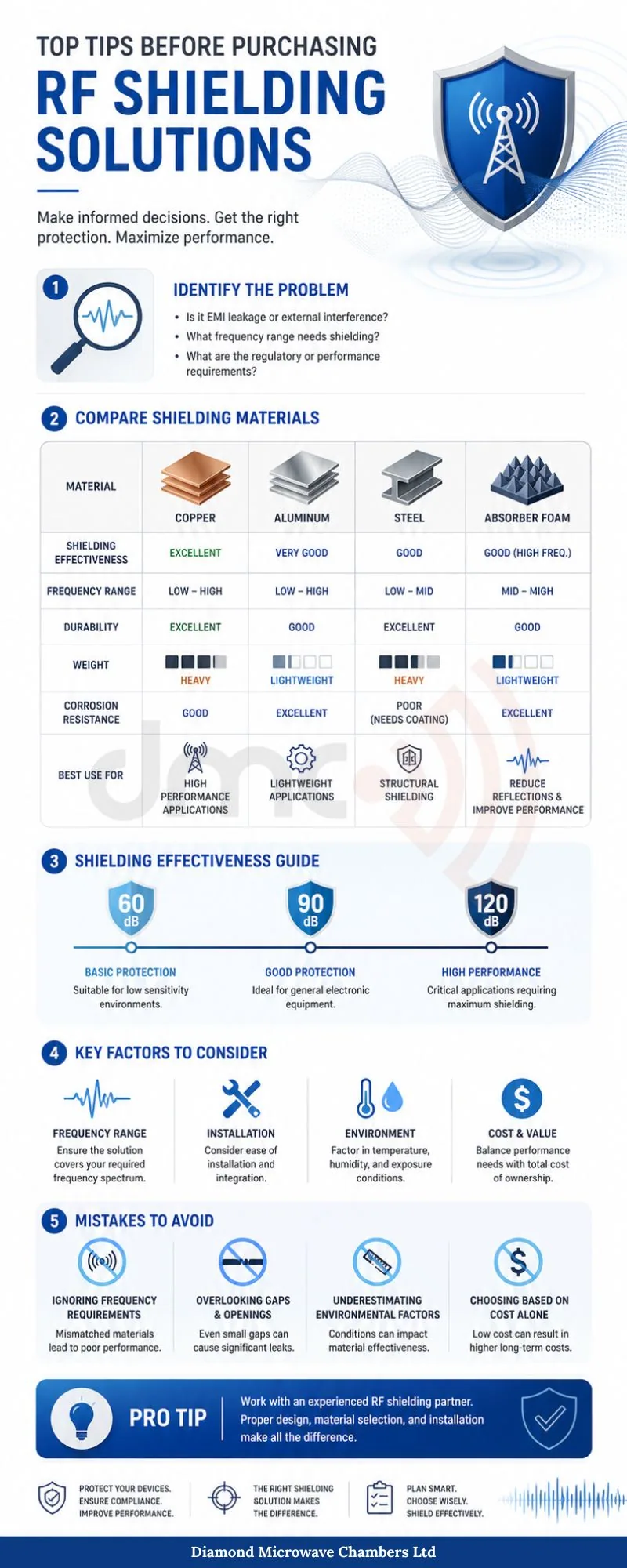
Material Choice Is More Than Just "Best Conductivity"
Many blogs say copper is the best - which is true technically, but not always practically.
Here's the real-world view:
- Copper -> Excellent but expensive and heavy
- Aluminum -> Good performance, easier to handle
- Steel -> Strong, but not ideal for all frequencies
- Absorber foam -> Used when reflection control matters
The key is balance. For many projects in India, aluminum-based solutions offer the best mix of cost and performance.
Understand Shielding Effectiveness Without Overcomplicating
You'll often see numbers like 60 dB, 90 dB, or 120 dB.
Here's what that actually means in simple terms:
- Lower values -> Basic protection
- Mid-range -> Suitable for most commercial use
- Higher values -> Needed for critical environments
Don't get trapped into thinking "higher is always better." Over-specifying can unnecessarily increase your budget.
Frequency Matters More Than You Think
Not all shielding materials behave the same across frequencies.
- Low-frequency interference behaves differently
- High-frequency signals are easier to block
If your system works across multiple bands, a single material may not be enough. This is where layered or hybrid shielding solutions become useful.
Installation Can Make or Break Performance
Even the best shielding material can fail if installed poorly.
Things people often overlook:
- Gaps in joints
- Improper grounding
- Poor sealing
For example, a perfectly designed shielded room with small leakage points can lose a significant amount of effectiveness.
So always think beyond the product - think about execution.
Environmental Conditions Are a Silent Factor
In many Indian environments, conditions like humidity and heat play a major role.
Ask yourself:
- Will the material corrode?
- Is it exposed to outdoor conditions?
- Will temperature affect performance?
Ignoring this can lead to degradation over time, which means your shielding weakens without you realizing it.
Cost Should Be Viewed Long-Term
Instead of asking "What's the cheapest option?", ask:
"What will perform reliably for the next 3-5 years?"
A slightly higher upfront investment can:
- Reduce maintenance
- Improve durability
- Avoid replacement costs
Cheap shielding often ends up being expensive in the long run.
Quick Comparison of Common RF Shielding Materials
| Material | Real-World Advantage | Limitation | Where It Works Best |
|---|---|---|---|
| Copper | High performance | Costly | Labs, defense setups |
| Aluminum | Lightweight, affordable | Slightly lower performance | General industrial use |
| Steel | Strong and durable | Heavy, less efficient | Structural shielding |
| Absorber Foam | Reduces reflections | Not for full blocking | Anechoic chambers |
Customization Is Often Necessary
Off-the-shelf solutions don't always fit perfectly.
In real projects, you may need:
- Custom dimensions
- Special thickness
- Combination materials
Ignoring customization can result in poor fitting and reduced effectiveness.
Always Check Certifications and Testing
This is where many buyers take shortcuts - and regret it later.
Make sure the product:
- Has proper test reports
- Meets EMI/ EMC standards
- Is verified for your use case
If a supplier cannot provide testing data, that's a red flag.
Supplier Matters More Than You Expect
A good supplier doesn't just sell - they guide.
Look for someone who:
- Understands your application
- Suggests the right solution (not the costliest one)
- Offers technical support
This becomes especially important for complex installations.
Pro Tip
Before finalizing your purchase, test the solution in a small setup or request a demo/sample.
Real-world testing often reveals issues that specifications alone cannot show.
Mistakes You Should Avoid
Let's be honest - most problems happen because of simple oversights:
- Buying based only on price
- Ignoring frequency range
- Skipping installation planning
- Not testing before bulk purchase
Avoiding these alone can improve your results significantly.
RF shielding isn't just a technical purchase - it's a strategic one.
The right choice depends on:
- Your exact requirement
- Environment
- Budget
- Execution quality
Take time to evaluate properly instead of rushing into a decision. A well-planned shielding solution will not only solve interference issues but also improve overall system performance.
Leave a Reply