RF Testing Setup: Chamber vs Open Environment
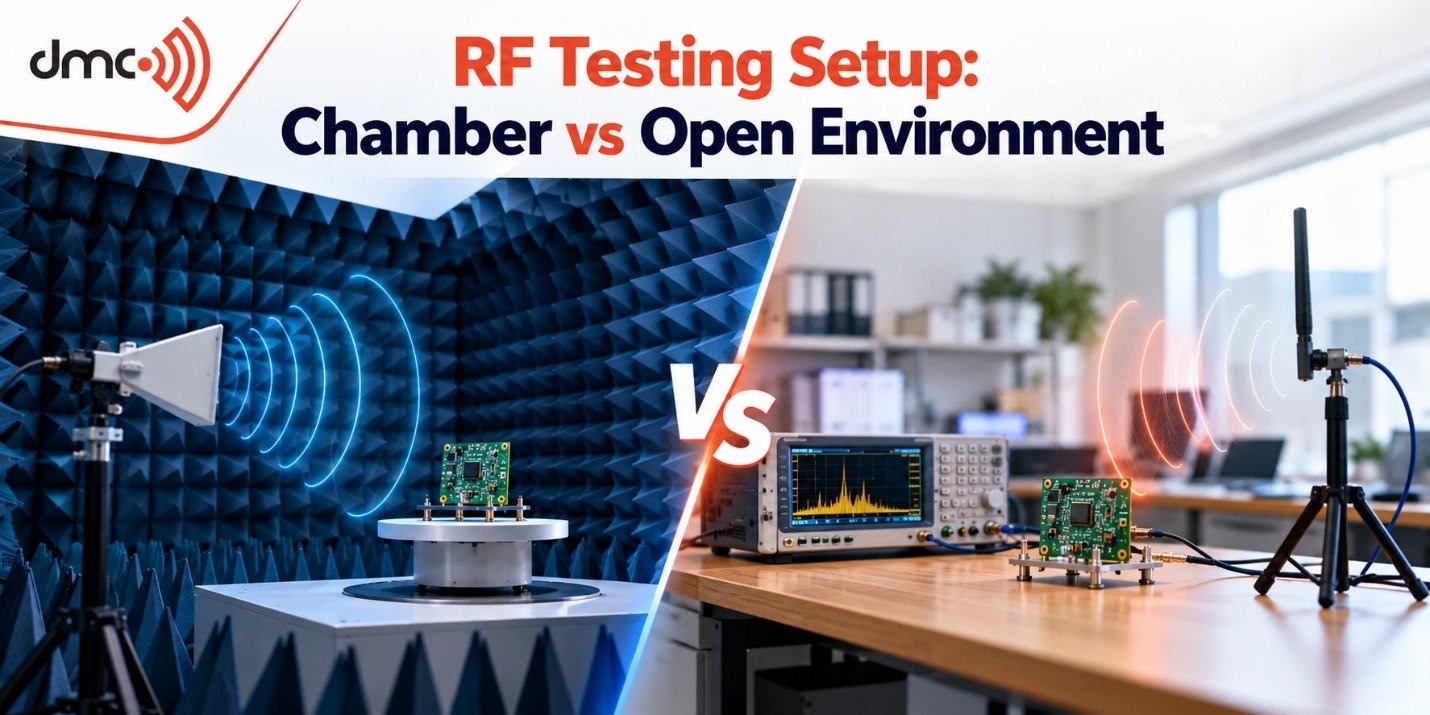
Table of Contents
- What Is an Open Environment for RF Testing?
- Chamber vs Open Environment: Key Differences
- When a Chamber Is the Better Choice
Every RF testing setup begins with one practical question: where should the test be carried out? Some teams measure a device on an open bench or an outdoor site. Others place it inside a shielded chamber or Anechoic Chamber. Both approaches are used, but they produce very different levels of control, repeatability and cost.
Diamond Microwave Chambers Ltd (DMCRF) works with laboratories and product developers who must decide between these options. This guide compares a chamber with an open environment, explains where each one fits, and helps you choose without overspending.
What Is an Open Environment for RF Testing?
An open environment means testing without an enclosure. It can be an ordinary lab bench, a large room, or a purpose-built open area test site (OATS) located away from buildings and strong signal sources. Some standards for radiated emissions testing were originally written around open-area sites, and they remain a recognised method.
The main advantage is simplicity, because no enclosure is needed. The main drawback is that ambient RF noise from Wi-Fi, mobile networks, broadcast transmitters and nearby equipment is always present, and weather can also affect outdoor sites.
What Is an RF Test Chamber?
An RF test chamber is an enclosure designed to control the electromagnetic conditions around the device under test. Two features are commonly involved:
- RF shielding: Conductive walls limit radio energy entering or leaving, which reduces outside interference.
- RF absorbers: Absorbing material on internal surfaces reduces reflections, as used in Semi-Anechoic and fully anechoic chambers.
A basic shielded enclosure provides isolation only. An anechoic chamber adds absorbers for measurements where reflections would distort results, such as antenna pattern or radiated immunity testing.
Chamber vs Open Environment: Key Differences
- Interference control: A chamber isolates the test from outside signals. An open site is exposed to them.
- Repeatability: Controlled conditions make results easier to repeat from day to day.
- Weather and access: A chamber is indoors and usable in any weather. Outdoor sites depend on conditions.
- Security: Enclosed testing keeps unreleased products and test signals private.
- Regulatory compliance: An enclosure also prevents your own test transmissions from interfering with nearby services.
- Space and cost: An open setup avoids chamber installation, but a suitable quiet site can be hard to find.
RF Testing Setup Comparison Table
| Factor | Chamber | Open environment |
|---|---|---|
| Outside interference | Strongly reduced by shielding | Exposed to ambient signals |
| Repeatability | High when properly verified | Varies with conditions |
| Weather dependence | None | Possible for outdoor sites |
| Reflections | Controlled with absorbers if fitted | Depends on surroundings |
| Initial investment | Higher | Lower for simple benches |
| Best suited to | Wireless, EMC and antenna testing needing control | Basic checks, or tests following open-site methods |
These are general descriptions. The correct choice depends on your test method and the standards that apply to your product.
How Ambient Noise Affects Your Results
In an open environment, unwanted signals can raise the noise floor of your measurement. This makes weak emissions harder to detect and can cause false readings, particularly when a nearby transmitter operates in the band you are testing. Signals also change through the day, so a test that looks clean in the morning may not repeat in the afternoon.
A chamber does not remove every uncertainty. Reflections, cable routing and equipment placement still influence results, which is why verification matters. However, a properly specified enclosure reduces the largest variable: the outside world.
Cost Considerations
An open environment has the lowest entry cost, but hidden costs can build up through repeated tests, travel to a remote site, or lost time waiting for suitable conditions. A chamber needs a larger initial investment covering the enclosure, installation and verification. For teams that test often, the added control and repeatability can justify the expense. For occasional checks, a smaller bench-top shield box may be a practical middle option.
When a Chamber Is the Better Choice
Consider a chamber when:
- You test wireless devices such as Wi-Fi, Bluetooth, cellular or IoT products.
- Ambient signals disturb your sensitive measurements.
- You need repeatable pre-compliance results during development.
- Your antenna measurements require a low-reflection space.
- Product confidentiality matters.
When an Open Environment May Be Enough
An open environment can be reasonable when:
- You perform quick functional checks that do not depend on precise RF levels.
- Your applicable standard specifies an open area test site.
- Surrounding noise is low and the measurement is tolerant of it.
- Budget and space do not yet allow a chamber.
Even then, record the surrounding conditions so results can be interpreted properly.
Common Mistakes to Avoid
- Assuming an open bench gives the same results as a chamber.
- Treating a Shielded Enclosure as if it were an anechoic chamber.
- Choosing a design before confirming the applicable test standards.
- Ignoring frequency range and equipment size requirements.
- Skipping performance verification after installation.
- Judging only on purchase price and not on long-term testing needs.
Pro Tip: Before deciding, run a short ambient noise survey at your planned test location using a spectrum analyzer. If strong signals appear in the bands you care about, a chamber is likely worth considering. Share the findings, device dimensions and frequency range with Diamond Microwave Chambers Ltd to discuss a suitable configuration.
Choose the Right RF Testing Setup
Neither approach is universally better. An open environment suits simple checks and methods written for open sites, while a chamber supports controlled, repeatable RF Testing where interference and reflections matter. Define your tests, standards and budget first, then compare options and confirm performance through verification. Diamond Microwave Chambers Ltd can help you explore chamber solutions suited to your RF testing setup.
Leave a Reply