What Are the Types of RF Anechoic Chambers?
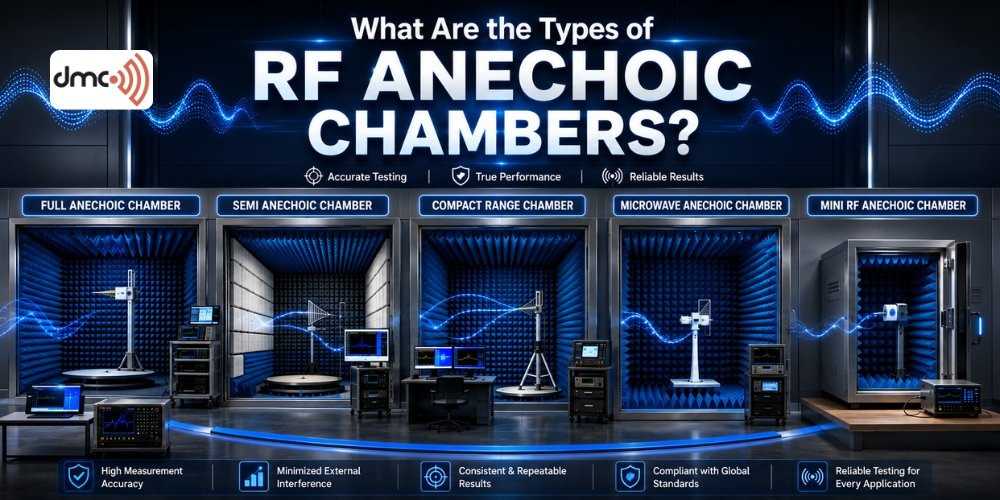
Table of Contents
- What Is an RF Anechoic Chamber?
- Types of RF Anechoic Chambers
- Choosing the Right RF Anechoic Chamber
Radio Frequency (RF) testing plays a critical role in developing modern wireless technologies. From smartphones and satellites to automotive radar and defense systems, accurate RF measurements are essential to ensure reliable performance. This is where Types of RF Anechoic Chambers become important. These specially designed chambers create a controlled electromagnetic environment by absorbing unwanted RF reflections, allowing engineers to perform highly accurate antenna, EMC, OTA, and microwave testing.
Whether you are setting up a new RF laboratory or upgrading an existing testing facility, understanding the Types of RF Anechoic Chambers helps you choose the right solution for your application. At DMC Shop, we provide high-quality RF testing solutions, RF absorbers, shielding products, and customized anechoic chamber components designed for research, industrial, aerospace, automotive, telecommunications, and defense applications.
What Is an RF Anechoic Chamber?
An RF anechoic chamber is a specially engineered room designed to absorb radio frequency energy while preventing external electromagnetic interference. The interior walls, ceiling, and sometimes the floor are covered with RF absorbing materials that eliminate reflections, creating an environment similar to free space.
This controlled environment enables engineers to perform precise measurements without interference from surrounding electronic equipment or external radio signals.
Main Features
- Electromagnetic shielding
- RF absorber-lined walls
- Low reflection environment
- High measurement accuracy
- Compliance with international testing standards
Why RF Anechoic Chambers Are Important
Modern electronic devices operate across increasingly complex wireless frequencies. Even small signal reflections can produce inaccurate test results.
RF anechoic chambers provide:
- Reliable antenna measurements
- Repeatable testing conditions
- Reduced electromagnetic interference
- Higher measurement accuracy
- Compliance with regulatory standards
Industries including aerospace, automotive, defense, healthcare, telecommunications, and electronics manufacturing rely on these specialized testing environments every day.
Types of RF Anechoic Chambers
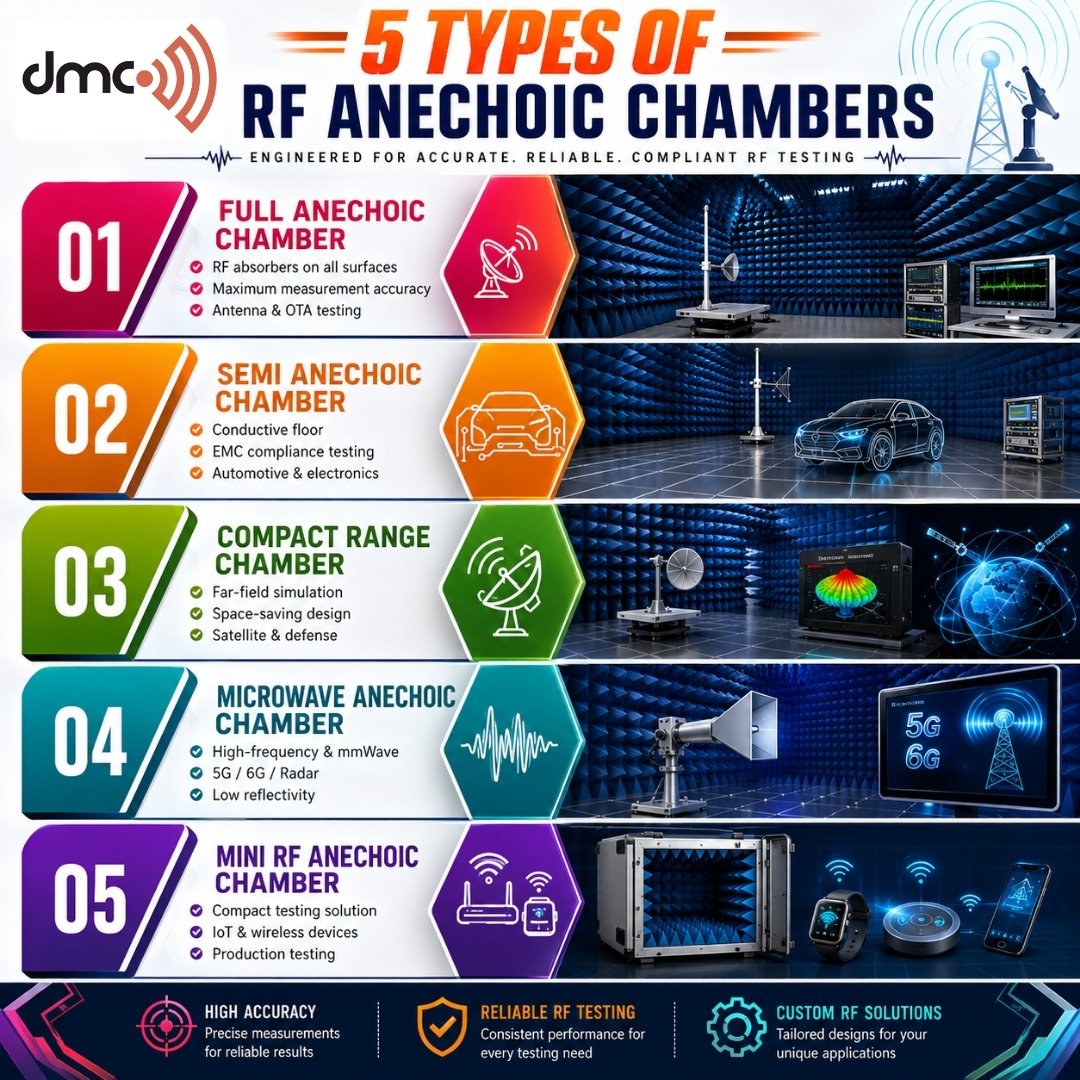
Different testing applications require different chamber designs. Below are the most commonly used Types of RF Anechoic Chambers.
| Chamber Type | Best For | Floor Treatment | Typical Applications |
|---|---|---|---|
| Full Anechoic Chamber | Maximum RF Accuracy | RF Absorbers on All Surfaces | Antenna Testing, OTA, Radar |
| Semi Anechoic Chamber | EMC Compliance | Conductive Ground Plane | EMC Testing |
| Compact Range Chamber | Long-Distance Simulation | Absorber-Lined | Satellite & High-Gain Antennas |
| Microwave Anechoic Chamber | High-Frequency Testing | Full Absorber | Microwave Systems |
| Mini Anechoic Chamber | Small Product Testing | Absorber-Lined | IoT, Electronics R&D |
1. Full Anechoic Chamber
A Full Anechoic Chamber has RF absorbing materials installed on every surface including the floor. This creates a true free-space environment with extremely low reflections.
These chambers are widely used for precision antenna measurements and radar testing.
Advantages
- Highest measurement accuracy
- Minimal signal reflections
- Excellent repeatability
- Supports advanced antenna characterization
Common Applications
- Antenna gain measurement
- Satellite antenna testing
- Military radar evaluation
- Wireless communication research
- OTA testing
2. Semi Anechoic Chamber
A Semi Anechoic Chamber features RF absorbers on the walls and ceiling while maintaining a conductive floor.
This design is ideal for electromagnetic compatibility (EMC) testing because it simulates real-world installation environments.
Benefits
- Cost-effective
- Supports EMC standards
- Easier equipment installation
- Suitable for large devices
Used For
- Automotive EMC testing
- Industrial electronics
- Consumer electronics
- Medical devices
- Regulatory compliance testing
3. Compact Range Chamber
Compact Range Chambers use specially designed reflector systems to simulate far-field conditions within a relatively small space.
Instead of requiring hundreds of meters between the antenna and measurement equipment, these chambers create an equivalent testing environment inside a compact laboratory.
Advantages
- Space-saving
- High accuracy
- Ideal for large antennas
- Lower infrastructure costs
Applications
- Aerospace
- Defense
- Satellite communication
- Large antenna arrays
- Radar systems
4. Microwave Anechoic Chamber
Microwave Anechoic Chambers are designed specifically for high-frequency RF and microwave measurements.
The absorber geometry is optimized for frequencies ranging from several GHz into millimeter-wave bands.
Features
- Optimized RF absorbers
- Excellent high-frequency performance
- Low reflectivity
- Suitable for mmWave technologies
Common Uses
- 5G testing
- 6G research
- Microwave antennas
- Radar development
- RF component evaluation
5. Mini RF Anechoic Chamber
Mini RF chambers are compact solutions designed for testing small electronic devices.
They are commonly installed in research laboratories and manufacturing facilities where space is limited.
Benefits
- Compact footprint
- Lower installation cost
- Easy integration
- Fast production testing
Applications
- IoT devices
- Wireless sensors
- Bluetooth products
- Wi-Fi modules
- Small antennas
Choosing the Right RF Anechoic Chamber
Selecting the correct chamber depends on several technical factors.
Consider the following:
- Testing Frequency
- Device Size
- Measurement Accuracy
- Compliance Standards
- Budget
Industries That Use RF Anechoic Chambers
Many industries depend on reliable RF testing environments.
- Telecommunications
- Automotive
- Aerospace
- Defense
- Research
Pro Tip
When selecting an RF anechoic chamber, think beyond your current testing needs. If your organization plans to develop products for emerging technologies such as 5G, 6G, autonomous vehicles, or advanced radar systems, invest in a chamber with higher frequency capability and modular absorber configurations. This future-ready approach can reduce upgrade costs and extend the lifespan of your testing facility.
Conclusion
Understanding the Types of RF Anechoic Chambers is essential for selecting the right testing environment for your RF and EMC applications. From Full Anechoic Chambers designed for precision antenna measurements to Semi Anechoic Chambers ideal for EMC compliance, each chamber type serves a unique purpose.
As wireless technologies continue to evolve, investing in the right RF testing infrastructure becomes increasingly important. DMC Shop provides reliable RF absorbers, shielding solutions, and chamber accessories that help engineers achieve accurate, repeatable, and industry-compliant results.
Leave a Reply